

Major Global Music Events — Spring & Summer 2026
Popular stations picked for you
International RadioFinder Feature
The global music industry enters the spring and summer of 2026 with a renewed sense of scale and confidence. Concert venues across continents are once again filled, international tours stretch across dozens of countries, and festival tickets sell out in hours. Live music has returned not only as entertainment but as one of the central engines of global culture, tourism, and digital media.
Where festivals once meant simply stages and audiences, today they function as cultural ecosystems. Music merges with technology, fashion, streaming platforms, influencer culture, and tourism economics. The 2026 season therefore represents more than a calendar of concerts; it reflects how the entire entertainment industry now operates.
The season traditionally begins in Austin, Texas, where SXSW opens the musical year.
Photo:

Photo author: Larry D. Moore / Wikimedia Commons
SXSW has evolved into far more than a festival. For a week the city becomes a living laboratory of pop culture. Small clubs host emerging artists, industry executives scan for future stars, and technology companies present new tools that may reshape how music is produced and distributed. Many artists who dominate global radio playlists later first appeared here in front of small crowds.
As spring continues, attention moves toward Florida and the Jazz in the Gardens festival in Miami.
Photo:

Photo author: Marc Averette / Wikimedia Commons
Despite its name, the festival illustrates one of the strongest trends of modern music: genres are dissolving. Jazz, R&B, hip-hop, pop, and soul coexist naturally on the same stages. Audiences increasingly follow artists rather than categories, and festivals like this demonstrate how the industry has shifted toward emotional identity rather than stylistic labels.
In April the global spotlight inevitably turns to California and Coachella.
Photo:
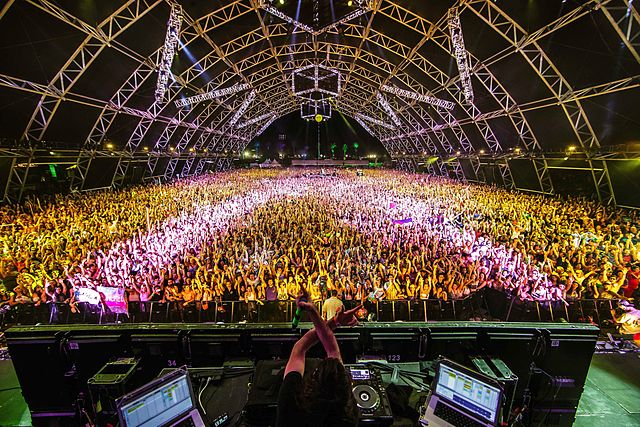
Photo author: Justin Higuchi / Wikimedia Commons
Coachella is no longer merely a music festival; it is a global media event. Performances instantly circulate across social media, fashion brands use the desert as a runway, and streaming services track dramatic spikes in artist listening immediately after headline shows. For digital radio platforms, the festival often marks the moment when the new international listening season truly begins.
Around the same time, California also hosts Stagecoach, the world’s largest country music festival.
Photo:

Photo author: Brian Bajorek / Wikimedia Commons
Stagecoach demonstrates how even historically traditional genres now embrace crossover performers. Artists associated with pop or hip-hop increasingly appear on country stages, reflecting a global audience that no longer consumes music inside rigid stylistic borders.
As summer approaches, Europe becomes the center of the festival world, beginning with Primavera Sound in Barcelona.
Photo:

Photo author: Alterna2 / Wikimedia Commons
Primavera has built its reputation on blending generations and scenes. Legendary alternative bands, experimental electronic artists, and emerging pop voices share the same lineup. Music journalists often treat the festival as a preview of what European radio playlists may sound like in the coming years.
By July, attention shifts to Switzerland and the Montreux Jazz Festival.
Photo:

Photo author: Rama / Wikimedia Commons
Montreux retains the aura of prestige that few festivals in the world can match. Although rooted in jazz history, the event now hosts performers across rock, pop, orchestral, and electronic traditions. Participation itself is widely seen as a symbol of artistic recognition.
At the same time, Belgium hosts Tomorrowland, perhaps the most visually ambitious electronic music event on the planet.
Tomorrowland transforms live music into large-scale theatrical production. Monumental stage architecture, immersive lighting, digital storytelling, and global streaming broadcasts turn the festival into a worldwide spectacle watched simultaneously by hundreds of thousands on site and millions online.
Germany also plays a significant role in the European season, particularly with Lollapalooza Berlin.
Photo:

Photo author: Steffen Prößdorf / Wikimedia Commons
The Berlin edition has become one of Europe’s most influential pop events, combining international headliners with rising European artists and reinforcing the country’s central place in the continental music circuit.
Meanwhile, Jazz Open Stuttgart offers a different atmosphere.
Held across urban architectural spaces, the festival blends open-air concerts with city culture, attracting audiences that span generations and musical tastes.
Beyond festivals, 2026 also marks the continued return of major global tours.
Photo:

Photo author: Raph_PH / Wikimedia Commons
Large touring productions once again cross continents, signaling that the global live music economy has fully recovered and that audience demand for shared musical experiences remains exceptionally strong.
Spring and summer 2026 therefore illustrate a central truth of modern music culture: today’s music event is not only a concert but a multimedia phenomenon, a tourism driver, a digital broadcast, and a defining component of the global entertainment ecosystem.